Project FLOW
Future Leaders Observing Watersheds. Project FLOW gives middle and high school students the same tools, the same data, and the same workflows that professional environmental scientists use. The premise is simple: scientific literacy doesn’t come from memorizing the water cycle — it comes from being invited into the work of doing science.
Most science education asks students to consume science. Project FLOW asks them to do it.
On the Carson River
The first Project FLOW deployment is at Eagle Valley Middle School in Carson City, Nevada, where students are monitoring the Carson River. A HOBO continuous logger sits in the water collecting temperature and dissolved oxygen records around the clock, and the classroom works that data through the full scientific process — import, quality control, correction, analysis, and reporting.
This is year one. The first cohort is generating the first dataset. Photos, classroom stories, and the year-end Hydrologic Report Card will be added here as the school year progresses.
See It Live
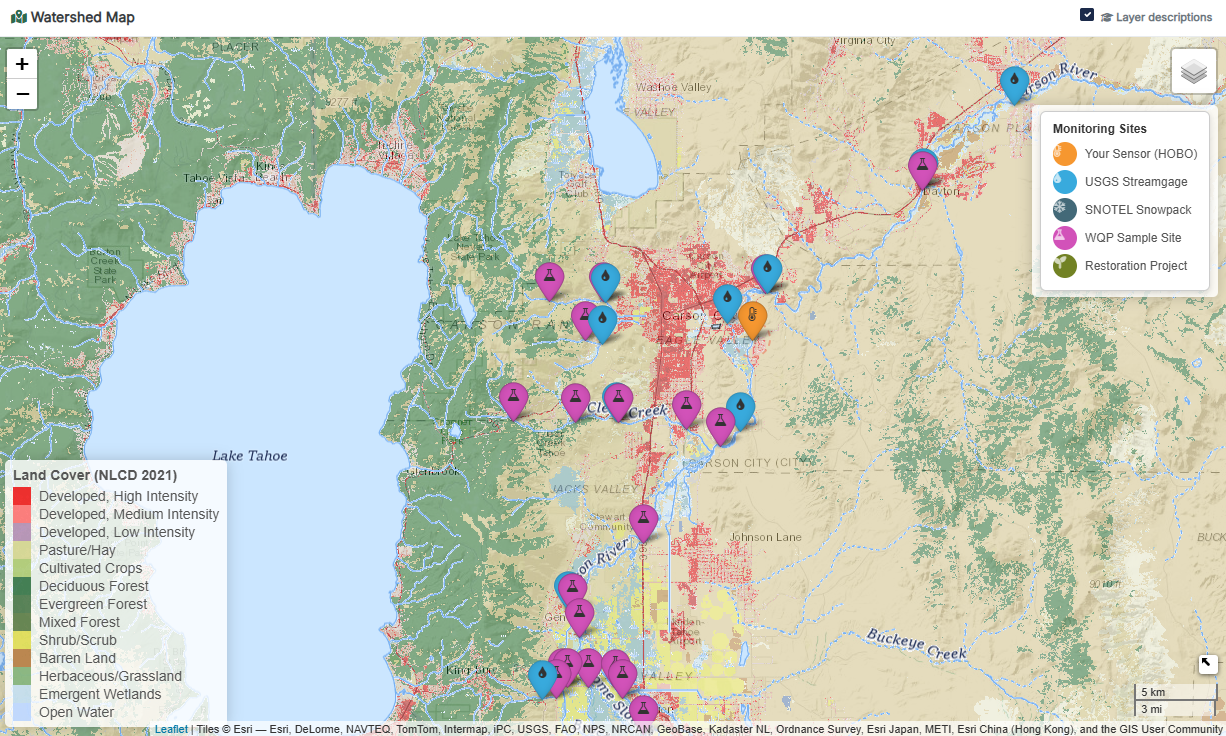
The Project FLOW app for Eagle Valley Middle School is publicly accessible — this is the actual deployment running in the classroom, not a sandbox. Below: the Project FLOW watershed map, showing the Eagle Valley sensor (orange) alongside the network of USGS streamgages, SNOTEL snowpack stations, and Water Quality Portal sample sites that students can compare their data against.
Open the live Project FLOW app →
Year-one data is still being collected, so the visualizations may be sparse early in the school year. The app architecture, parameter dictionary, regulatory criteria, and EduStream narratives are fully active.
What Makes Project FLOW Different
Real data, not classroom data
Most K–12 water curricula give students cleaned, pre-packaged datasets to “analyze.” Project FLOW does the opposite. Students work with raw sensor records — the same files a USGS hydrologic technician would receive — including drift, fouling, and gaps. They learn what turbidity is by looking at their own turbidity data. They learn what a fouling correction is by applying one to their own sensor record.
Stealth pedagogy: EduStream
Project FLOW includes EduStream, a narrative engine that teaches environmental science concepts as students work through their data. Lessons are triggered by what the data is actually doing — a temperature exceedance, a snowmelt cascade, a dissolved oxygen anomaly — and progressively unlock as students demonstrate understanding. Learning happens in context, not in a separate worksheet.
Built to professional standards
Project FLOW shares its data infrastructure with CEDAR — DANalytics’ underlying analytics engine. The QC algorithms, audit trails, citation engine, and parameter dictionary are designed to agency standards, and student observations are recorded in the DANalytics water quality schema — a structured record format built for cross-program comparability and downstream regulatory submission. Student data is scientifically defensible because the rigor lives in the software architecture, not in the user’s expertise level.
What Students Do
- Deploy and maintain a continuous water quality sensor on a real waterbody
- Import sensor data and discrete grab samples through the FLOW app
- Apply automated QC checks and review flagged readings
- Correct sensor drift and fouling using documented agency methods
- Export clean, citation-backed datasets in submission-ready format
- Generate a year-end Hydrologic Report Card for their site
The Hydrologic Report Card
At the end of each school year, Project FLOW generates a Hydrologic Report Card — a parameterized scientific document that tells the story of the class’s year in data. Parameters are graded against state water quality criteria. Seasonal patterns are summarized. Weather and snowmelt events are connected to river response. Field visits are documented with photos. Every QC decision the class made is preserved, and every data source and methodology is fully cited.
The report is bound, sent home with the student, and serves as a real scientific deliverable — the kind a watershed group or environmental agency would produce. The first issue will be generated at the end of the 2025–2026 school year.
Bring Project FLOW to Your School
Project FLOW is designed to be deployed at additional schools, with each deployment configured for the local waterbody, regulatory criteria, monitoring parameters, and curriculum connections — no software changes required. With adapted curriculum, the same software supports youth monitoring programs run by watershed organizations and tribal environmental departments.
To discuss bringing Project FLOW to your school or program, contact daniel@danalyticsenv.com.
Built on Open Data
WQP · USGS · NOAA · NASA POWER · ATTAINS
- Posted on:
- January 1, 0001
- Length:
- 4 minute read, 724 words
- See Also: